
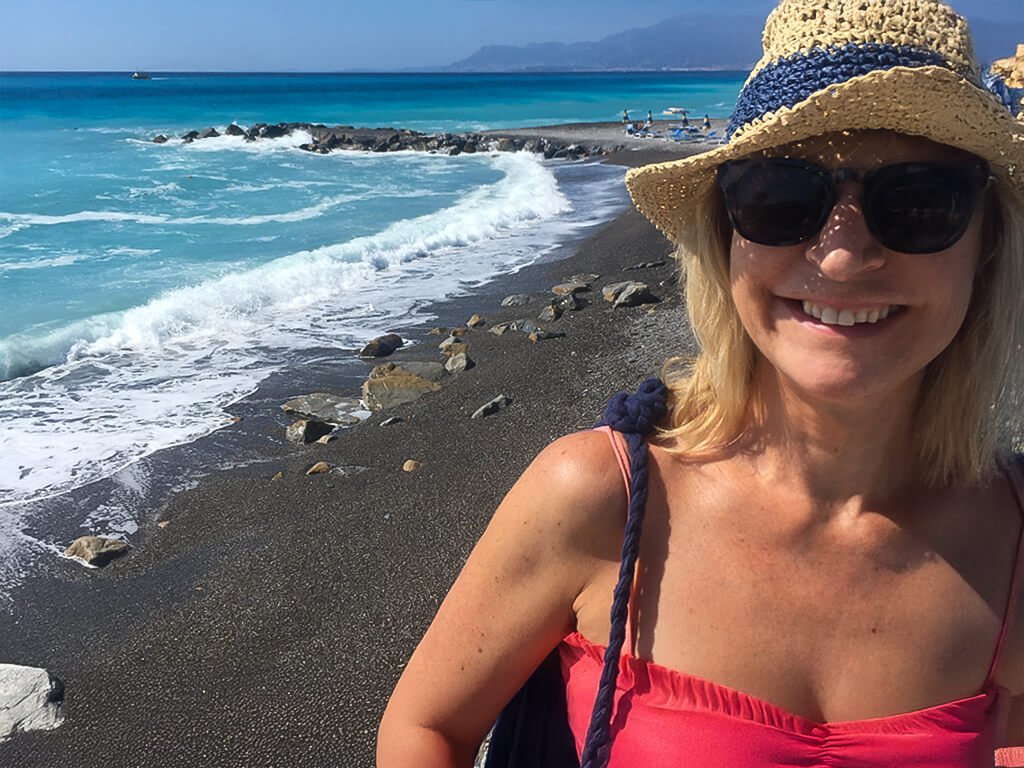
The first village at the foot of the hills, above the sea, was born already around the 5th century BC and the inhabitants were engaged in agriculture and herding. But that’s only because there was no tourism yet 😊.
The first church, now called Saint’Ampelio, was built on the site where a religious hermit from Egypt used to live in a cave among the rocks. Subsequently, a monastic priory was built here, which fell under the French abbey of Lerins(Ile de Lerins is the island opposite Cannes😊, still belonging to the abbey but accessible to tourists by cruise ship).
The name Bordighera probably comes from French and means artificial lagoon, which was used by fishermen who apparently lived here on the hill above the church of Saint’Ampelio.


In more recent history, Bordighera has been swapped between French and Italian abbeys , and subsequently some of the 15 local families who inhabited the town as early as the 13th century AD decided in the 15th century to found a modern town here, which then meant a fortified village high above the hill overlooking the sea.
Like the other Ligurian towns and villages, Bordighera was under the influence of the Genoese kingdom and was subsequently not left out by Napoleon, on whose orders “La Grande Corniche” was brought to Bordighera, a road at 400 m above sea level, connecting Nice to Italy, which facilitated the connection and development of new neighbourhoods near the sea(and which makes it easier for us to arrive in Nice to this day 😊) and the Bordighera as we know it today was born. After the fall of Napoleon, Bordighera then fell to the Kingdom of Sardinia.
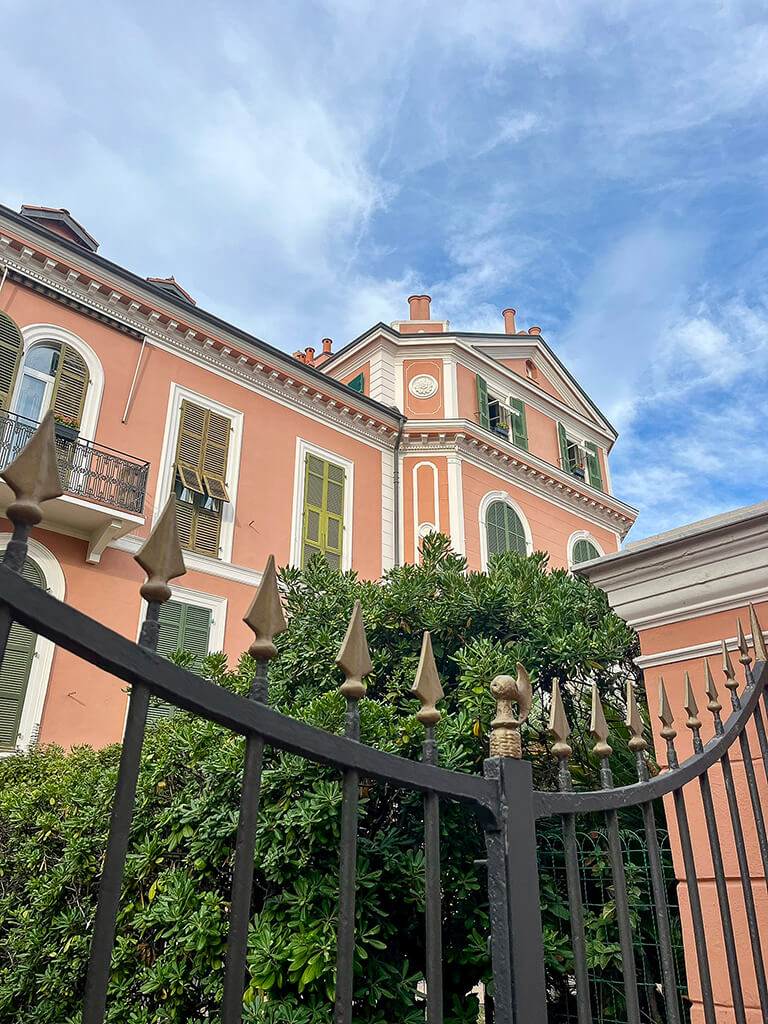
Later on, it was enough for Giovanni Ruffinni to mention Bordighera in his novel Doctor Antonio, published in Edinburgh in 1855, to arouse the interest of the English. In 1860, the first Hotel d’Angleterre (now Villa Eugenia- pictured) opened here and in 1872 the local railway station was inaugurated, connecting Paris and Bordighera in just twenty-four hours.
So the elite could start riding in big😊. We wouldn’t have made it here from Prague in 24 hours by train even today…😃
Former Hotel dAngleterre
And since there was such a fast and convenient connection, Claude Monet himself travelled here from Paris in 1884.
Bordighera charmed him and gave him a hard time too. According to an article by Ilaria Baratta, published on 03/03/2019 on Finestre sull arte, Monet was initially worried that he would not be able to transfer the beauty of the surroundings, the motifs and the atmosphere to the canvas. In his letters to his wife in Paris, he wrote: “I am straining a great deal because I still cannot understand the tone of this country; sometimes I dread the colours I must use, I fear they will be horrible, and yet I am still very much down; the light is terrible.“
He was utterly fascinated by the local landscape, the rich green of the lush vegetation, the bright colours of the citrus fruits, the shades of blue offered to the eye by the sea and the sky, which very often changed from day to day, and above all the light.
In the end he had to get new paints from Turin and his Bordighera paintings were of course great 😊. But after finishing them, he expressed concern to his art dealer that “the enemies of blue and pink will cry a little because of the splendor, the fantastic light, and those who have never seen this landscape or have seen it wrong will surely cry out at the improbability “😊. Indeed, Monet had never before used blue on his palette, with a tendency towards violet for the sky and atmosphere, pink or apricot for the flowers, emerald green for the sea water, and these new colours and atmospheres initially drove him to despair for fear that he could not render it all on canvas.
And Bordighera was not left out by one Stéphen Liégeard, who gave the French Riviera its name when he began to call it the “Cote d’Azur” (Côte d‘Azur), and in his famous book La Côte d’Azur, published in 1887, he devoted several pages to Bordighera and nicknamed it the “Queen of Palms“.