
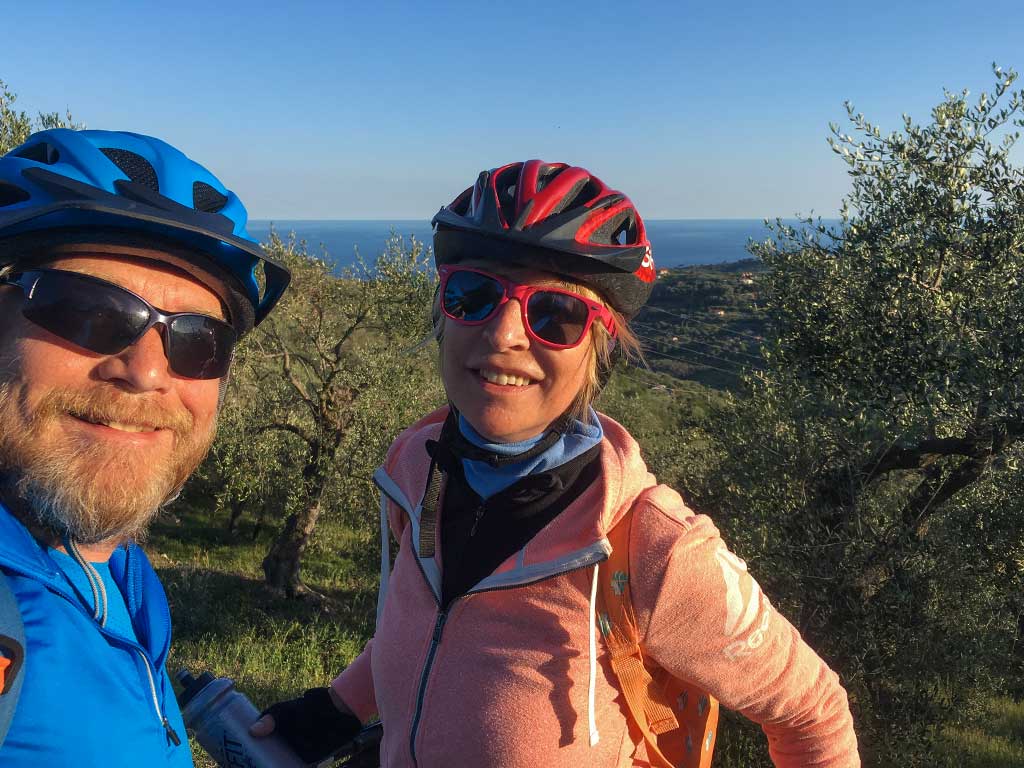
I read on Google that Liguria is the most forested region in Italy. It has deciduous trees such as chestnuts, ash trees and oaks, just like in the Czech Republic. However, as I wrote in Part 1 about olives, it is mainly olive trees that grow along the Ligurian coast, which makes up almost half of Liguria’s borders.
Looking out from our terrace I can see the seain the distance and above it the olive trees😊. They grow up to an altitude of 600 meters above sea level, which is not a problem in Liguria because the terrain is mountainous and only 5% is lowland, and of course only immediately around the sea. Above us, in fact just a short distance from the sea, is Monte Faudo, which can be seen as soon as we leave our village its height is please 1151 m above sea level.
Olive trees have been growing here for hundreds of years and are neatly arranged in rows on the steep rocky slopes (you won’t find flat land anywhere further from the sea), which are separated by cascading stone walls built on dry land in times long past.
and I always wonder how hard-working the Ligurians must have been back then to have managed this in this difficult terrain, and that the walls are still standing!
Everyone, at least in our village (sorry, in the “borgo”), who owns a terreno has an “ulivetto” (olive grove) or at least a few olive trees in the garden.
Everyone combs the olives and has them made into their own olive oil in the local small frantoio (pressing plant). Those who don’t make oil pickle the olives in brine – Olive salamoia, which lasts up to 6 months. Preserved, but also fresh olives are then suitable for caponata, salads, fish, meat, well, I would say that here in Liguria they are added to practically everything.
Once you see the name of the dish on the menu with the addendum “ala Ligure” you can bet it will be on the tomato and olive sauce😊.
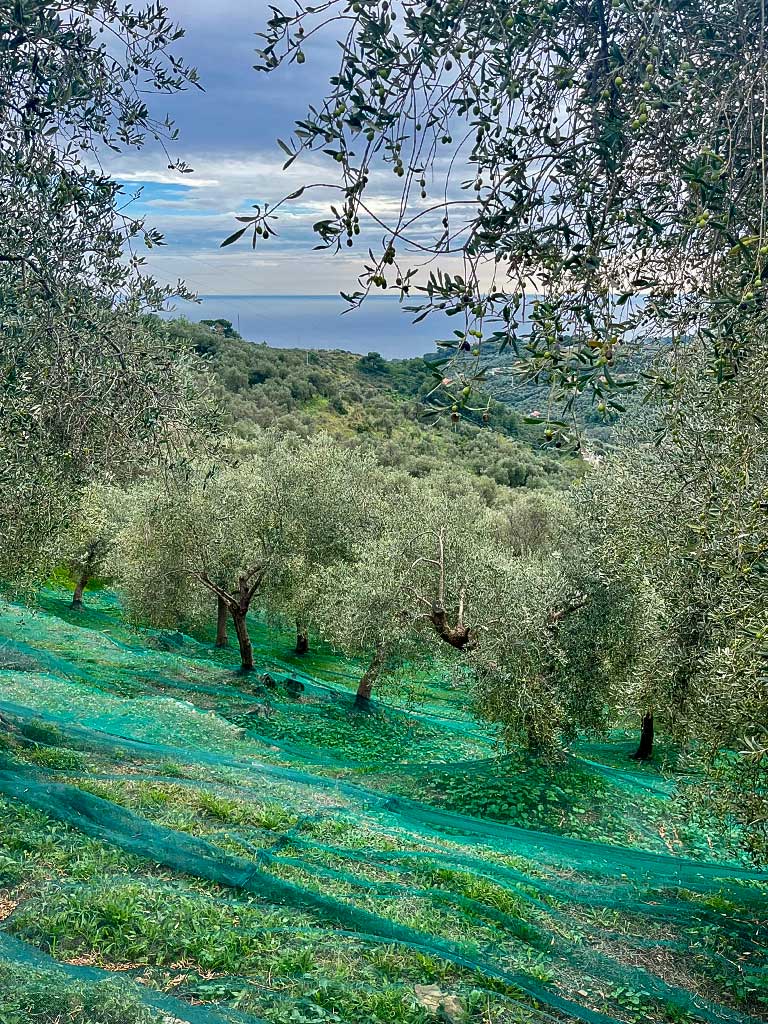
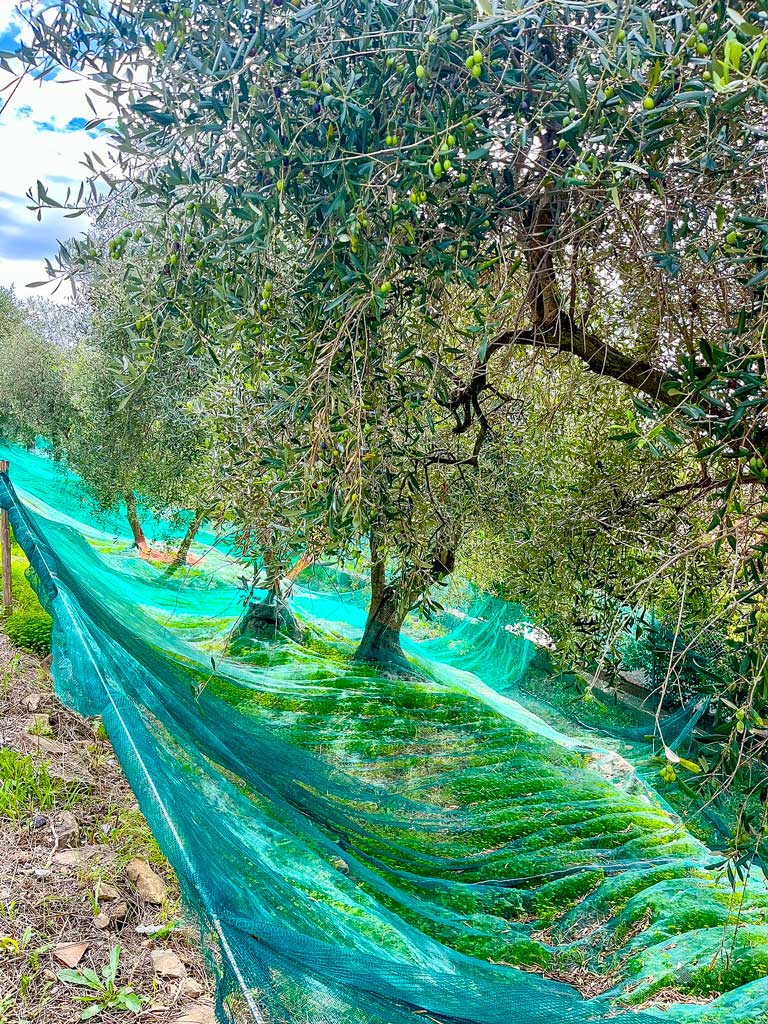
Every year we eagerly await the start of the olive harvest, every time I pass an olive tree up close, I check to see if it is already starting to turn blue, because the green and black olives are the same variety, and then the familiar sound of the muffled rattling of combs announces the beginning, under its onslaught, the olives fall into the mostly dark green nets that have been hanging tangled on the trees and now wait impatiently, carefully spread out under the trees. In our country, the harvest usually begins in mid-October. The weather is also important, or rather the air temperature, because if it is too warm, insects, by which the Italians mean pests, thrive, so it is important to be on the lookout for them and to be careful not to attack the olives. That is also why they say that olives from Liguria are so good, because there are fewer pests in the hills and, in general, the higher the olive tree grows, the less it is attacked by insects.

Full-page-oliv
Ani-oliva-nazmar
Zidky-full-oliv
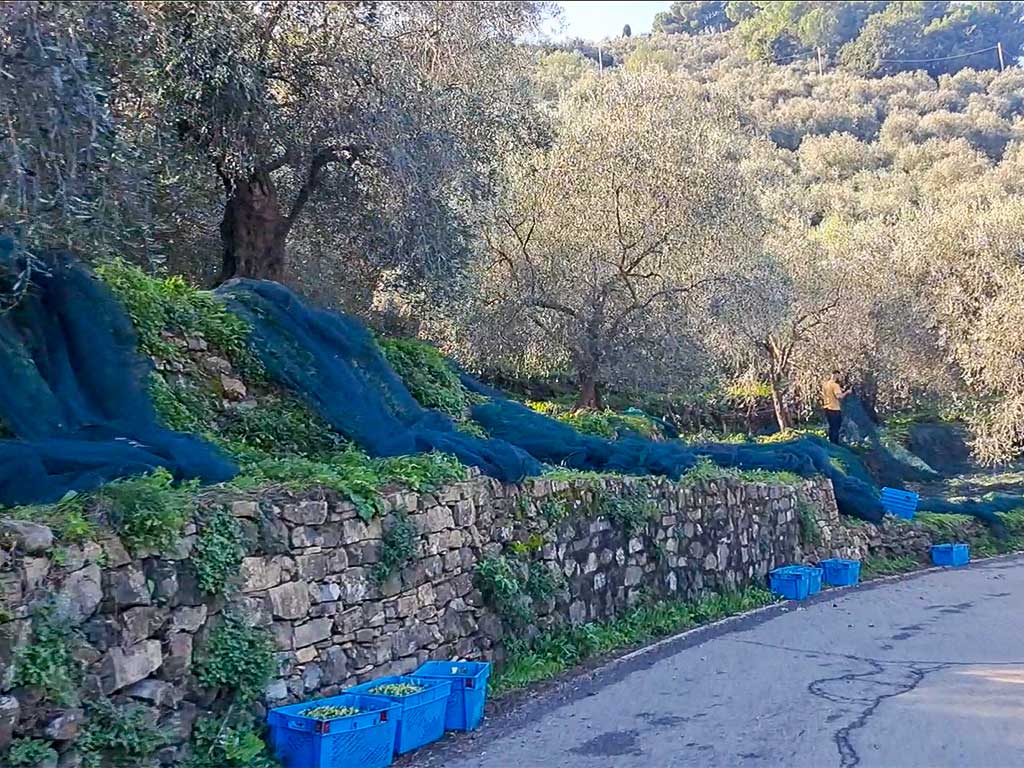
The olives are even combed by hand to produce the finest oil, and the price corresponds to this. However, the standard method of harvesting olives is an electric comb – a kind of oscillating fork on a long pole that is used to drop the olives into the nets. Those who have more land and more olive trees also hire seasonal helpers for the harvest. Like this year, for example. This year, after three years, the harvest was finally big, thanks to the fact that it finally rained during the year. But it also rained at harvest time, which of course made the work more difficult. I think, however, that everybody and their helpers managed to finish and were satisfied.
I helped our neighbours with the harvest 2 years ago, and they welcomed it, but I almost kidnapped the garlic. Well it’s a job for the guys 😊.
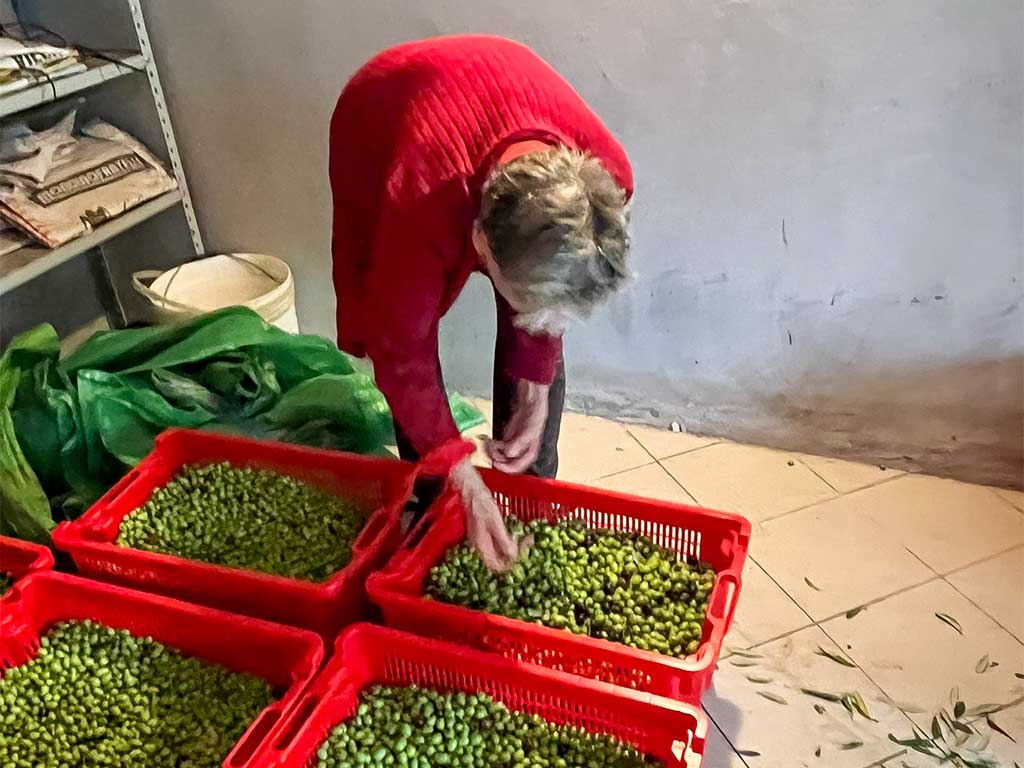
So at least together with Clara I was piling olives from the nets into boxes, which seems like a trivial matter, but the nets are huge, the terrain under the olives is steep and complicated and there are stone walls everywhere 😊. It’s hard work, some places the trees are so difficult to access, by the roads and small roads, so maybe traffic has to stop for a while.
Well, let me tell you that I had my hands full and my hat off to Clara, she is 82 years old… Clear proof that the Mediterranean diet (olive oil 😊) and regular exercise are a guarantee of fitness until old age.
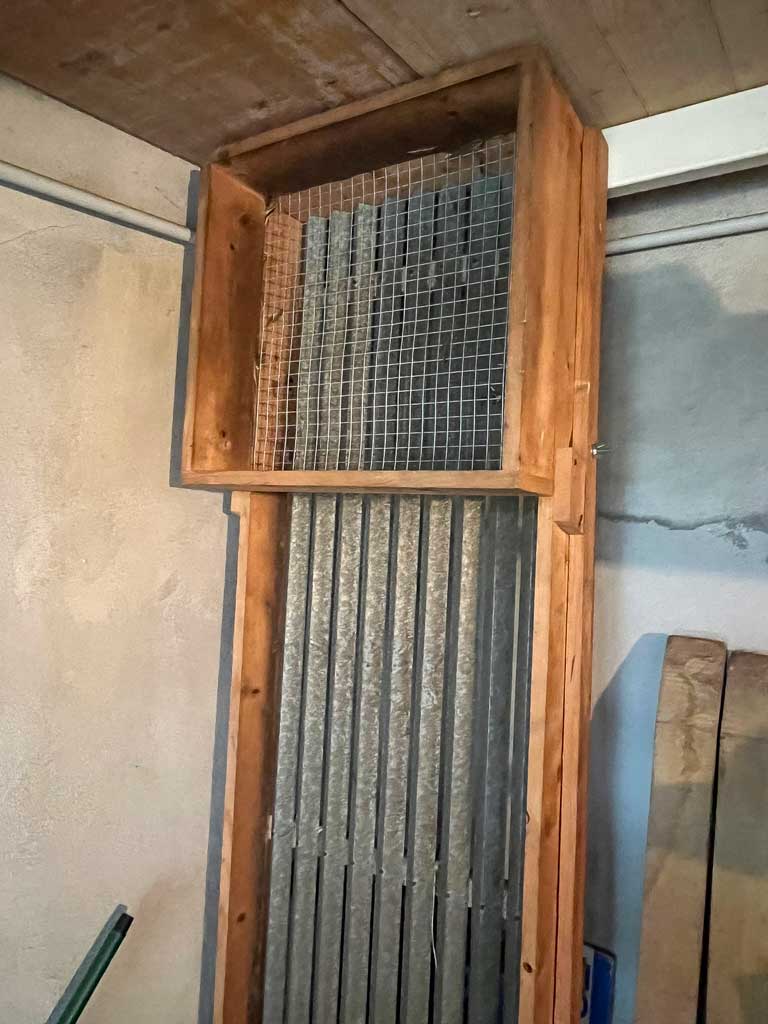
Old-machine-for-removal-sheets
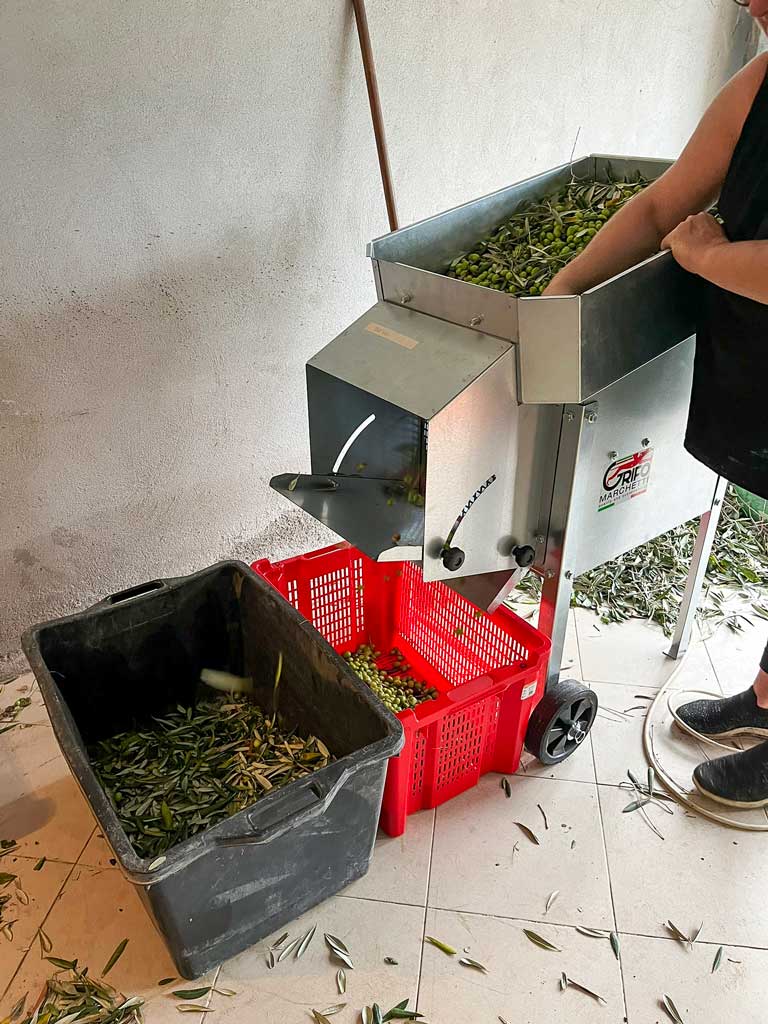
New-machine-for-removal-sheets
Neighbour Clara
Although we too have a cantina (no I don’t mean a corporate snack shop) in our house, in Italian cantina means cellar, like I’m sure many of our neighbours, the remains of an olive leaf, nowadays no longer pressed at home. They all take their picked olives to one of the local mills, usually only a few kilometres away, and there they press them into a thick, stretchy, greenish-yellow oil. In our area, everyone goes to Torre Paponi, which is about 5km from us, where there are 2 small pressing plants.
One barrel of about 12 kg (about 1 tree) of olives yielded an average of 1 bottle of oil this year, but it always depends on the quality of the olives, the water and oil content and it varies from year to year. That’s why the locals are reluctant to give you these specific figures.
This year, the olives contained more water (because it rained a lot and often before harvest), but enough oil was finally pressed and the leaves are still being pressed. It was just more expensive because the mills, like our cider mills, charge by weight of material delivered (olives) and not pressed 😊. Those who had enough olive oil for themselves, their family and those who like to buy from them, therefore they sell the olives to the bigger mill processors and the oil goes more to the world.
Of course, we explored the small pressing plant where our neighbors in Torre Paponi go right after the 1st season. As the locals are duly proud of their work and processes, they took us in without any problem (even with a cloak, yes it was that covid time) and showed us how the pressing process works and explained everything properly. And we did the right thing, because of course the pressing plants are being modernized and improved, the machines are being replaced and for example in Badalucco, where the oil is produced under the ROI brand, which is really premium quality and the price corresponds to it😊, you don’t see much nowadays, they have a new machine, where the olives are poured and run through the whole system, which is of course hidden from the eyes of visitors (and workers) and at the end you just see fresh thick green olive oil flowing out.
So it’s a good thing that last year we went to the second pressing plant in Torre Paponi and filmed a direct report😊. The owner was more than nice, happy to show off, inviting us in immediately and coming down to the house to get a bottle of wine to welcome us and generally to make sure we didn’t spend time there just to dry out😊.
It’s a sweet life in a village where time has stopped, people are not in a hurry (you can’t even do that with an olive press 😊) and they keep the traditions and because they are Italians, they love to chat. We tasted the oil and of course bought a bottle too, the first one from the new 2023 edition 😊. Well it’s long gone! 😊
I’ll show you a video with a report from the pressing plant and the olive harvest on Facebook! 😊